Seal First or Fail Fast Against the Invisible Foe That Ruins Everything
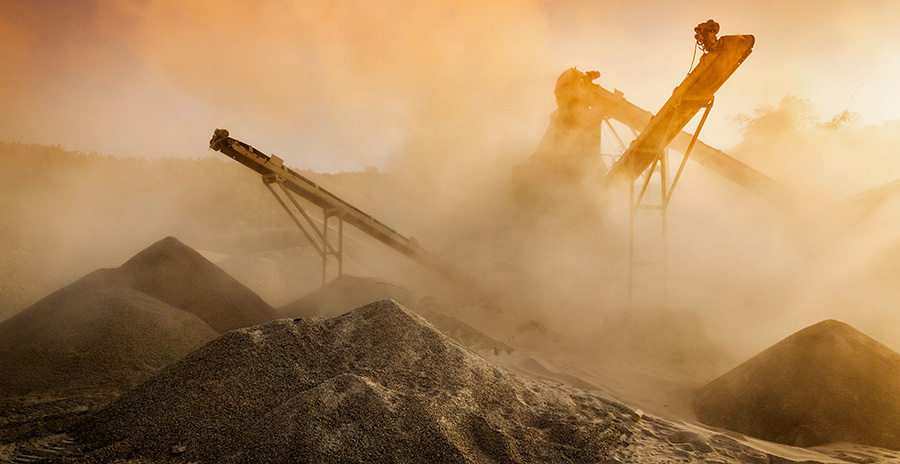
Oscar Castro, March 3, 2026 | When you think about the challenges of lubrication in mining operations, “extreme loads” is likely the highest item on your list. And sure, the loads are massive. But there’s also an unglamorous, quiet killer out there that rarely takes center stage: dust.
In mines, dust is more than just a nuisance. It’s all over the place—in the air, on surfaces, caking hoses, and worst of all, sneaking into lubrication points. That is where the real damage starts.
Consider the bushings in joints and pivot points in mobile equipment such as haul trucks, loaders, and excavators. These parts have mere microns of running clearances. If a single dust particle gets through, the lube turns into an abrasive paste. And rather than cutting down on friction, it causes wear to develop even more quickly.
Well, here’s the dirty little secret: The best protective grease isn’t the one with the most load capacity—it’s the one that seals the best. That’s not a popular opinion. Everyone wants the grease with the highest drop point, the best Timken score, or the most extreme-pressure (EP) additives. But none of that makes any difference if dust comes in, because then it’s game over.
And no, slathering on more grease isn’t the answer. Over-greasing actually opens a path for contaminants to enter. The surplus leaks out and carries grit particles, which are reintroduced into the system during the subsequent process cycle. The result? A gritty cocktail that chews through your assets.
So, rather than ask how much pressure your grease can handle, ask this instead: Can it seal?
The Load Myth and the Experience Trap
Field technicians with decades of experience in the trenches are invaluable, but even those grizzled pros can get caught in the experience trap. “We’ve always used this grease” is not a valid reason to continue using it.
MLT I, MLT II, and MLE certifications are not without merit. These credentials are not just pleasing to hang on a wall; they train you to think critically, to ask questions such as:
- “What are the actual needs of the component?”
- “What are the failure modes?”
- “What’s going on inside the joint at the microphysical level?”
In mining, everything is bigger, whether it is dust, vibration, temperature, load, or exposure to water or chemicals. The environment is harsh, and the lubrication can’t be generic. It must be strategic.
And, yes, you do need to think about whether or not your chairs are “load bearing.” But there’s a catch: sealing must be guaranteed. A high-EP grease that can’t keep dust out is like using a small bandage on a gunshot wound.
This is where so many fail. They watch the grease seep through and assume it’s doing its job. But the real question is: Is the grease passing through the whole bushing, or just being canceled out at the surface?
There is no way to know other than through technical validation:
- Knowing how the grease is flowing inside
- Mapping out application points
- Controlling pressure and flow in central systems
- Implementing ultrasound-based condition monitoring
Lubrication isn’t a guessing game. It’s an engineering discipline. That’s what makes good condition monitoring—with ultrasound, vibration analysis, or thermal imaging—so important. It tells you what your eyes do not.
Programs that adhere to best practices, such as those articulated by the ICML 55.2 Standard, comprise more than just paperwork. They are frameworks for turning maintenance from reactive to predictive. From “we fix when it breaks” to “we prevent it from ever breaking.”
Grease Selection is a Business Choice
At its core, this is not only a maintenance issue. It’s about strategy. It’s a business decision to select the right lubricant. It affects asset reliability, production uptime, safety, environmental compliance, and cost management.
And in mining—where margins are tight, and downtime is a predictable, inevitable catastrophe—nothing lazy happens. The best grease isn’t the one with the most impressive specs but is the one that:
- Seals effectively against abrasive contaminants
- Secures with vibration and washdown resistance held in place
- Flows well to fill all contact areas in a bushing
- Wards off attack by other chemicals such as acid or moist air
- Can be tracked and adjusted based on performance in the field
Let’s analyze that with reference to a real situation. Say you’re in a high-dust environment where heavy machinery is working 24-hour shifts. Selecting a complex, aluminum-polyurea, thickened grease with excellent washout resistance can:
- Double your bushing life
- Cut grease consumption by 40%
- Reduce instances of unscheduled downtime caused by locked-up joints
Yes, the per-kilo price might be higher. But when that grease can help prevent unplanned downtime, optimize labor hours, and prolong asset life, the ROI becomes evident. It is not an expense but an investment.
But such an investment only pays off when it’s steered by knowledge. Knowledge backed by data. And analyzed by people who know and understand tribology, system dynamics, and how harsh the environment really is in mining operations.
So, the next time you evaluate lubrication practices, focus on the critical questions:
- Are we sealing or just greasing?
- Are we truly tracking flow and distribution?
- And, above all, are we relying on guesswork and paperwork, or on real data and technical validation?
Because in mining, dust doesn’t wait. It infiltrates. It destroys. But with the right lubrication strategy, you can stay ahead of it and turn your maintenance from reactive to predictive.